



























It’s not hard to see why. Cloud computing offers unmatched levels of effortless flexibility, scalability, and cost-efficiency, far beyond what traditional on-premises data centres can provide. Both the Ocado Storage and Retrieval Solutions (OSRS) and Ocado Mobile Robot Solutions (OMRS) are powered by cloud logistics Software as a Service (SaaS).
So while other automation providers may offer cloud alongside legacy on-premises solutions, Ocado customers benefit from the distinct advantages that come with this fully native cloud logistics approach.
What is the Cloud?
The cloud is a global network of servers, storage, and other compute resources upon which companies can store and manage data, run applications and deliver content and services. Physically, the cloud is powered by data centres—giant facilities full of powerful computers, all connected to each other and to the Internet. These data centres run virtual computers (VMs, or virtual machines), each dedicated to a specific task yet with all the near-infinite compute power of the cloud behind them.
Rather than owning and maintaining physical hardware on-site, businesses rent compute resource from a cloud provider. The cloud provides virtually limitless computing power and storage, with the added benefits of flexibility and cost savings—since companies only pay for what they use. Cloud providers also have orders of magnitude more staff maintaining their services, resulting in a higher quality and more reliable service than could ever be expected from internal private infrastructure teams.
By offloading compute to the cloud, edge devices (from laptops and smartphones to cars and industrial machines) don’t need to be as powerful in themselves. As an example, many of us now have a smart speaker at home or in our car, featuring a built-in voice assistant. The physical speaker we use to communicate with this assistant is actually a very basic, low-powered device—incapable of responding itself. The cloud does all of the heavy lifting in terms of recognising your voice and formulating a response.
Cloud logistics, which refers to the use of Cloud-based technologies and platforms to manage various logistics and fulfilment functions, is a growing market and a fundamental enabler of Ocado’s warehouse technology.
Latency, and why it’s so important
Latency is the speed at which an action receives a response. To return to our earlier voice assistant analogy, latency is the time it takes for data (being a recording of your voice) to travel from your smart speaker to the cloud, and for the formulated response to be sent back to your device.
Latency can be introduced through a number of factors, from the strength of your home WiFi to network congestion, server response time, bandwidth limitations, and the physical distance between data centre and endpoint infrastructure.
For a smart speaker, it might make the difference between a natural conversation and waiting a number of seconds for a reply. In cloud logistics, however, achieving ultra-low latency is mission-critical to maintaining the efficiency of robot orchestration and movement.
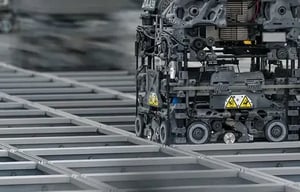
In our automated warehouses, the Warehouse Execution System (WES) controls the movements of robots—sending instructions to potentially thousands of robots up to ten times per second. Given our robots move at speeds of up to four metres per second (passing within just five millimetres of each other), every millisecond counts.
Calculating each robot’s next move is a hugely complex computational challenge in itself. But transmitting these instructions to each robot in real-time requires extremely low latency. For example, an immediate stop command must be actioned near-instantly; as little as a 1 second delay could have major consequences on robot orchestration.
Latency is the single most important factor in operating a high-throughput, fast-moving Automated Storage and Retrieval System (ASRS) such as OSRS, and it plays a key role in the story of Ocado’s journey from legacy on-premises hardware to today’s cloud-native mindset.
Ocado’s cloud journey
Before the advent of the cloud, on-premises (on-prem) data centres were the norm in offices, warehouses and industrial locations. These were physical rooms filled with racks of servers, storage arrays and other hardware. They were expensive to buy, assemble and operate, required extensive IT expertise to maintain, and were hard to scale.
As an operator of our own automated warehouses for over 20 years, Ocado has extensive experience running its proprietary warehouse management system (WMS) and WES on on-prem equipment. At the beginning of our journey, the Cloud was still evolving, and high-speed Internet technologies were yet to become commonplace. On-prem gave us the required predictable, low-latency communication and guaranteed throughput we needed. This meant paying for the ongoing costs of server hardware, power consumption, and of course dedicating physical space within our warehouses to storing on-prem equipment.
Yet we were using cloud logistics extensively elsewhere; in our supply chain, e-commerce, logistics and last-mile delivery streams serving our grocery warehouses, and in big data analytics to optimise the end-to-end process.
With cloud logistics becoming a central part of modern warehouse automation, we recognised the enormous potential in migrating OSRS to the cloud. So in 2019, we began to explore the viability of transitioning all of our active warehouses to a SaaS model.
Through extensive simulation and then real-world testing in our grocery warehouses, we explored various latency scenarios to understand how much delay the WES could tolerate without impacting performance. The results were hugely promising, delivering latencies as low as 100 milliseconds—well within the range required for optimal operation.
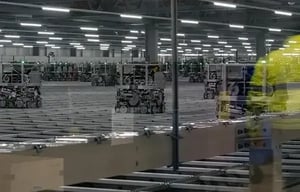
With this data in hand, we successfully migrated all instances of our WES to run on the AWS cloud platform. We now orchestrate over 10,000 robots from the cloud across all of our live OSRS sites. This shift has had a tremendous impact on our operations—we no longer need on-site IT specialists to manage hardware, as the entire system can be remotely managed via the cloud. And because we have access to near-infinite compute, we can easily scale up as a warehouse grows or new sites are added.
Today, AWS’s global infrastructure allows Ocado to operate warehouses worldwide while maintaining peak performance. And by removing the capex associated with installing on-prem data centres, we’re able to deliver OSRS to customers far more rapidly and with less initial outlay.
Building on AWS with the Ocado Developer Platform
Underpinning our cloud journey is the Ocado Developer Platform (ODP)—a fully managed, enterprise-grade Platform-as-a-Service (PaaS) built on AWS. ODP started life by helping our logistics and fulfilment engineering teams streamline cloud operations. Today, it is the foundation across all of Ocado's engineering, delivering consistency and efficiency at scale.
We built ODP to remove infrastructure complexity from the equation. It delivers a friction-free developer experience while embedding security, governance, and consistency by design. By orchestrating AWS services and automating best practices, it allows teams to build and deploy without needing deep cloud expertise.
This approach empowers our engineers to move faster and with greater confidence, unlocking AWS’s elasticity, reliability, and compliance capabilities without the burden of managing the underlying implementation. The result is faster delivery, lower operational cost, improved reliability, and a developer experience that scales with our global ambitions in warehouse automation.
Cloud in the Ocado Storage and Retrieval Solutions (OSRS)

Our Warehouse Execution System (WES) orchestrates robot movement across our OSRS automated storage and retrieval system (ASRS) grid. Hosted in the AWS cloud and using the Google Cloud Platform™ (GCP) for comprehensive big data analytics, the WES is our ‘air traffic control system’—a suite of microservices built on industry-standard solutions. These microservices manage bin locations, control our pick stations and communicate with robots via base stations located adjacent to the OSRS grid. All of the calculations and algorithms around these extra functions are executed in the cloud with no latency cost.
We employ an Ocado-developed proprietary communications system, using unlicensed 4G spectrum, to communicate with the robots. This ensures efficient, real-time communication across thousands of endpoints, allowing for the precise orchestration required to keep pace in such a high-throughput environment.
As a cloud-native solution, WES is able to constantly achieve peak performance, with the highest throughput, at the lowest cost.
Cloud in the Ocado Mobile Robot Solutions (OMRS)
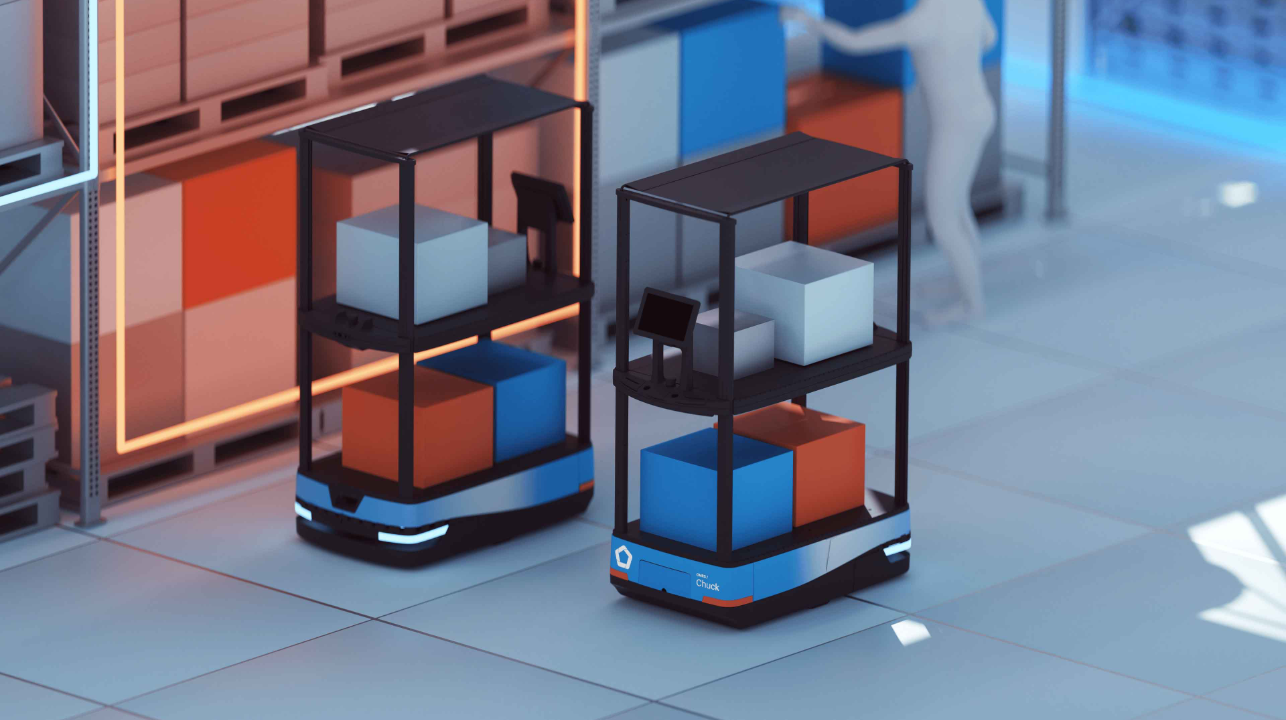
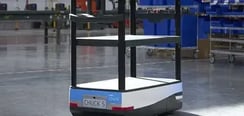
Our Fulfilment Execution System (FES) is a best-in-class fulfilment execution system for our OMRS mobile robot solutions. It optimises and prioritises work to be done by our Chuck AMRs (autonomous mobile robots), maximising productivity at the lowest feasible operational cost using system-directed workflows. It leverages cloud logistics to enable seamless coordination between robots and the warehouse floor operations, via a suite of different technologies provided by Google Cloud™.
FES’ cloud-based orchestration layer coordinates software and hardware based on a customer’s open pool of work, communicating with each Chuck to coordinate all the work on your floor and resulting in a fleet of Chucks working seamlessly and collaboratively alongside your employees to boost productivity of key warehouse operations including putaway, pick, sort and packout.
Chuck facilitates system-directed picking, leading employees to stock and then carrying items on behalf of human operators, who walk around the warehouse to pick and replenish items with the assistance of the robots in dedicated “picking zones.”
FES is designed to ‘hook in’ to your existing WMS, forwarding picking tasks to the cloud. As a cloud-native solution, it’s inherently scalable—whether you have 1 or 100 AMRs in operation.
We use Google BigQuery™ for analytics applications, uploading all robotics data to enable us to assess performance at a network, warehouse, and individual Chuck level. It also allows us to answer all kinds of questions: what is the average speed across the entire fleet? Are there any individual robots that are performing slower than others? At a single customer site, are there some aisles which are much slower than others? These insights can be used to monitor our fleet and proactively help our customers.
In the above image, you can see that most aisles have a similar average speed, but there are a few aisles where the average speed is significantly lower. We can use this information to help understand why certain units are slower in those aisles and take steps to mitigate the problem. Without the Cloud, we wouldn’t be able to assess our entire fleet in such granular detail.
What is AWS?
Amazon Web Services (AWS) is the largest cloud computing platform, with 34% market share. AWS is a ‘hyperscaler’—offering a broad range of large-scale services, from storage and compute power to artificial intelligence (AI). Businesses choose AWS for its resiliency, global reach, scalability, and extensive security credentials.
Ocado chose AWS as its primary cloud partner for several reasons:
Resiliency
AWS operates a global network of ‘Availability Zones’ (AZs) organised into Regions. The chance of an AZ failing is incredibly rare (generally due to a major act of nature). However, our WMS operates in multiple AZs to ensure that should an AZ fail, service continues. This level of resilience is difficult to achieve with on-prem systems without incurring significant costs.
Scalability
AWS’s elastic computing resources allow customers to scale up and down dynamically. OSRS is designed not to require significant scaling during peak periods—however, should you decide to extend your warehouse and grid or open another facility, the compute capacity required is instantly accessible.
Global Reach
AWS’s global presence, with data centres close to Ocado’s customer sites all over the world, helps minimise latency. AWS Regions are isolated from others to enhance fault tolerance and ensure low latency by keeping data processing close to the end user. AWS customers can choose specific Regions to deploy resources based on performance, regulatory requirements, and redundancy needs.
Security
AWS adheres to industry-leading security standards, including ISO 27001 and SOC 2, which are crucial for protecting sensitive data. AWS also provides robust tools for encryption, identity and access management, and network security.
Ensuring globally reliable service
Today, an Internet connection capable of transmitting and receiving the levels of data required to operate a cloud logistics solution such as OSRS can be found in even the most remote corners of the world.
For OSRS, we recommend a telecommunications service provided by a Tier 1 internet service provider (ISP) and potentially a secondary Internet connection to ensure redundancy in case of a loss of service. Maintaining uptime is vital, especially in warehouses completing hundreds of orders an hour.
However, we recognise that in some geographies, the gigabit speeds found in major cities may not be available. We’ve optimised our software to compensate for the increased latency and packet loss of some internet connections - so wherever in the world or how rurally your warehouse is located, we are likely to provide the same reliable and robust service we see in our own warehouses.
Cloud enables data-driven optimisation
Running our WES and FES as SaaS in the cloud enables a data-driven approach to operations by providing real-time access to vast amounts of operational data. Using advanced analytics tools, Ocado can continuously monitor and analyse performance metrics, robot efficiency, and warehouse throughput.
This data is used to identify patterns, detect bottlenecks, and uncover opportunities in our cloud logistics model, enabling continuous optimisation. By applying insights derived from this analysis, Ocado can implement incremental improvements that enhance performance over time. The result is a system that evolves to deliver better efficiency, reliability, and cost-effectiveness.
On-Grid Robotic Pick shares SKU learnings globally via the cloud
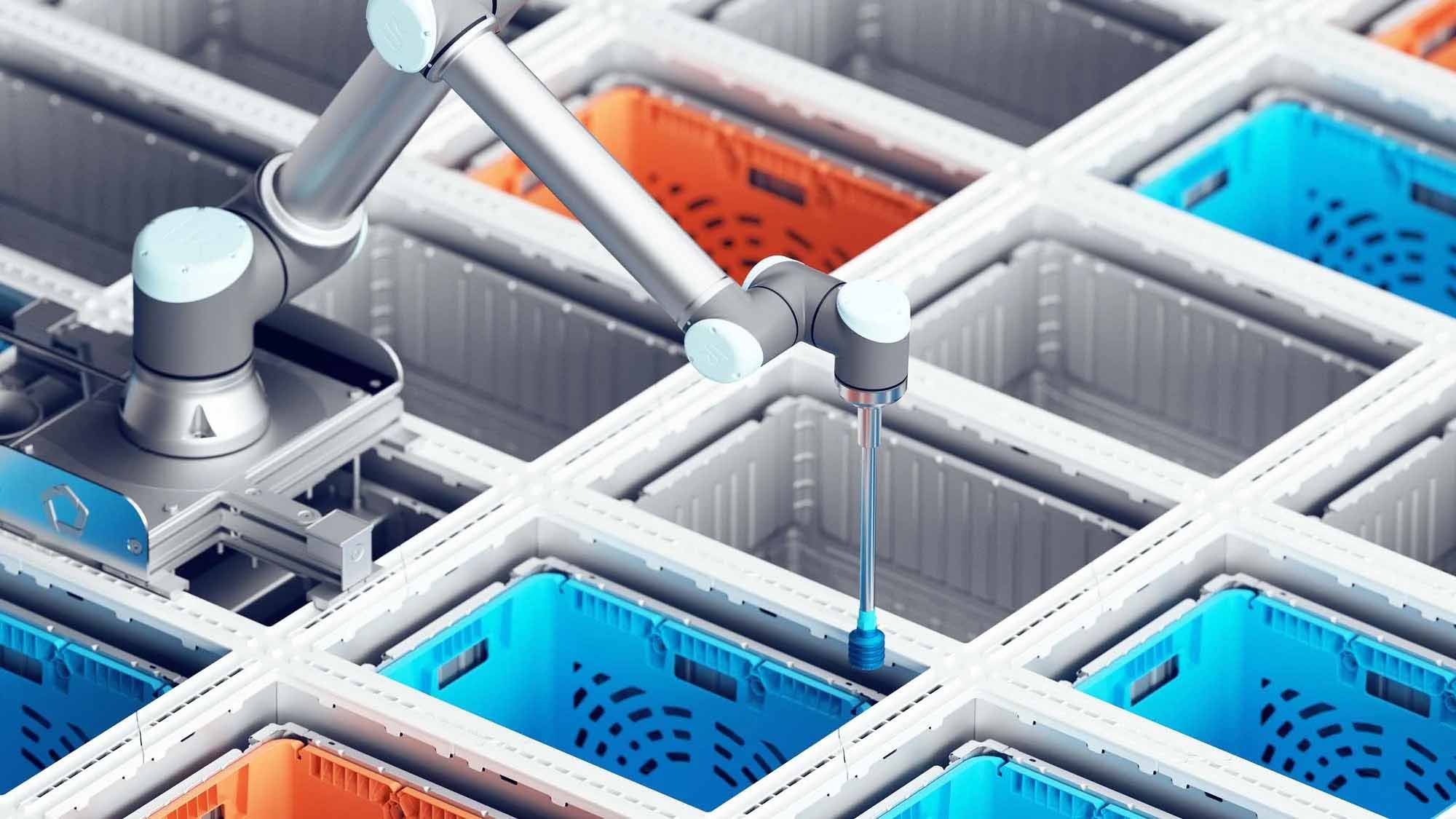
Data generated by our robots is used to directly improve their capabilities, too. Our On-Grid Robotic Pick solution sees robotic arms deployed directly on the OSRS grid. Combining cutting-edge computer vision and advanced sensing, On-Grid Robotic Pick identifies, picks and packs items from storage bins without prior knowledge of what they contain.
On-Grid Robotic Pick uses deep reinforcement learning to train itself to make faster, more dexterous handling decisions on the fly for new, potentially delicate items—protecting them from damage and maximising packing density.
These learnings are stored in the cloud and then shared across all Ocado On-Grid Robotic Pick systems globally, allowing each robot to learn from every new pick. With these incremental advances shared across all of Ocado’s sites, the whole network benefits from this cloud-native innovation.
Dispelling the myth: Cloud security vs. On-prem security
A long-held misconception is that cloud logistics is inherently less secure than on-premise solutions. Concerns over data governance and security remain the number one barrier to cloud adoption today. However, cloud providers like AWS offer top-tier security features that often exceed the security measures of on-premise data centres.
AWS provides extensive security tools, including encryption, identity and access management, and network security, all of which are crucial for Ocado’s operations. Hyperscalers like AWS adhere to strict industry certifications, such as ISO 27001 and SOC 2, ensuring that data is protected according to the highest standards.
Ocado takes data security very seriously. We are compliant with SOC 2, Type 2 data security standards, which assess a service organisation’s controls and safeguards over time, focusing on security, availability, processing integrity, confidentiality, and privacy. So you can ensure that your company’s data remains secure, from edge to cloud.
Ocado: Proudly cloud-first
By leveraging cloud logistics, we’ve been able to reduce launch times for new warehouse sites, scale our operations globally, and handle demand fluctuations with ease. The flexibility, scalability, and robust security provided by this cloud-native approach have allowed Ocado to focus on innovation while maintaining the highest levels of performance and data security.
As Ocado continues to expand and deliver cutting-edge warehouse automation, cloud logistics will remain at the core of their strategy, enabling us to remotely orchestrate OSRS across the globe with precision and reliability.